

Africa OS, building a digital foundation for the continent
A platform that gives African institutions a shared infrastructure layer so they can build better software without starting from scratch every time.
When you build software for hospitals, schools, banks, and government services across Africa, you start to notice a pattern. Every institution needs the same things. Authentication. User management. Permissions. Billing. Audit logs. File storage. Yet every time a new system gets built, someone writes all of that from scratch.
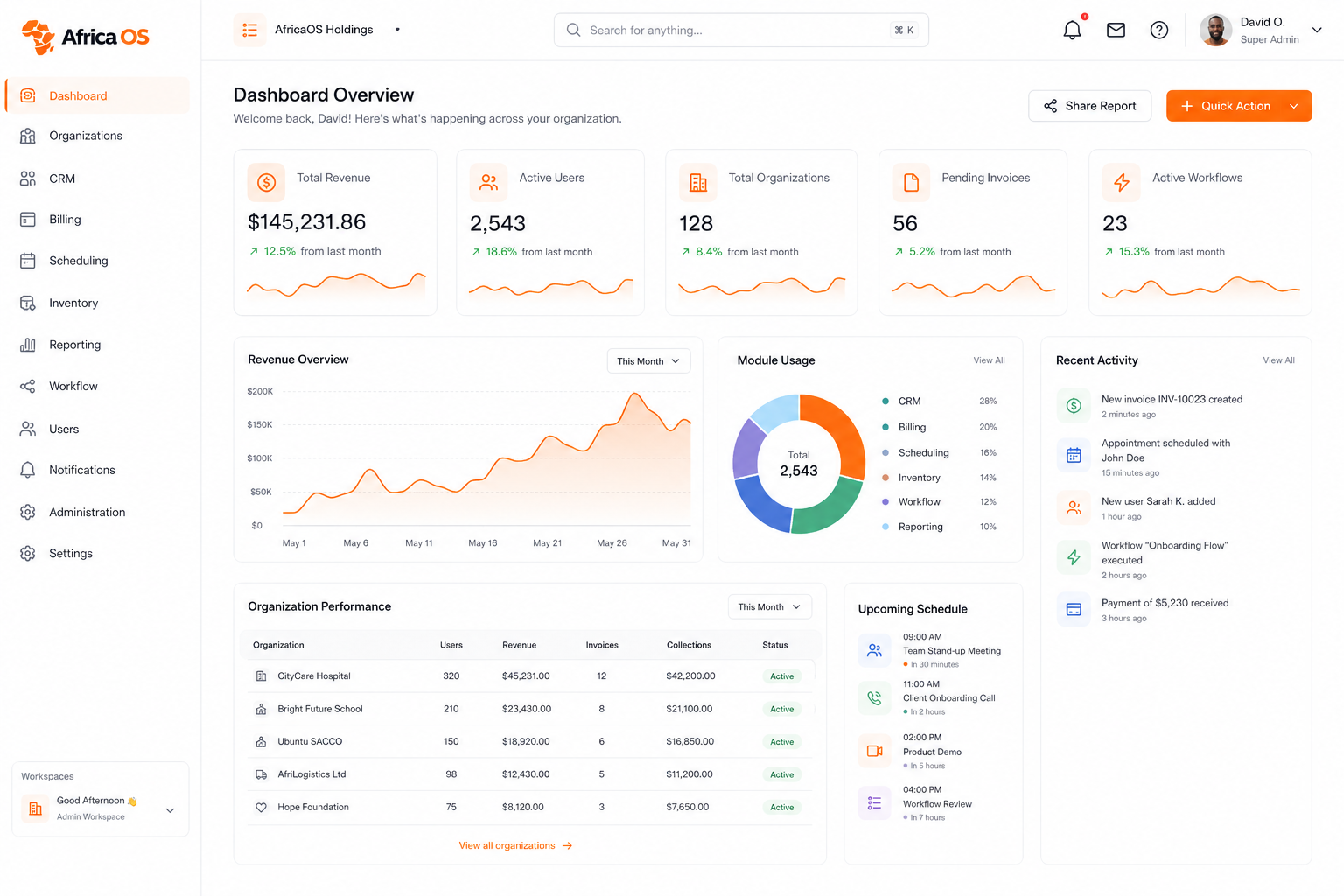
Africa OS is my attempt to stop that cycle. It is a modular infrastructure platform that provides a shared core kernel for building institutional systems. Think of it as a foundation you never have to lay twice.
The idea is simple. Instead of rebuilding authentication, multi tenancy, organizations, roles, events, notifications, billing, subscriptions, and file storage for every project, you get all of that out of the box. Then you plug in the domain modules you actually need.
Healthcare. Education. SACCOs (savings and credit cooperatives). CRM. Government services. Each domain is a separate module that sits on top of the same core. The core handles the heavy lifting. The modules handle the specifics.
This matters because Africa has a lot of ground to cover. The continent is young, fast growing, and full of people building things that matter. A clinic in rural Uganda needs a patient management system. A school in Nairobi needs an exam platform. A cooperative in Ghana needs loan tracking. Right now, each of those gets built in isolation. Africa OS gives them a shared starting point so developers can focus on what makes their system different rather than rewriting the same backend logic over and over.
The vision is not about one platform ruling everything. It is about reducing the friction of building good software for institutions that need it most. If a developer in Lagos can spin up a hospital system in a day instead of six months, that is a win. If a government agency in Kigali can integrate its services without hiring five different vendors, that is a win.
The video above walks through the architecture in more detail. It covers the core kernel, the module system, how multi tenancy works, and where this is headed next.
What I am most excited about is the long tail. There are thousands of institutions across Africa doing critical work with outdated or nonexistent software. Africa OS does not solve all of their problems. But it does make it significantly easier for developers to build the solutions they need. And that feels like a step in the right direction.